
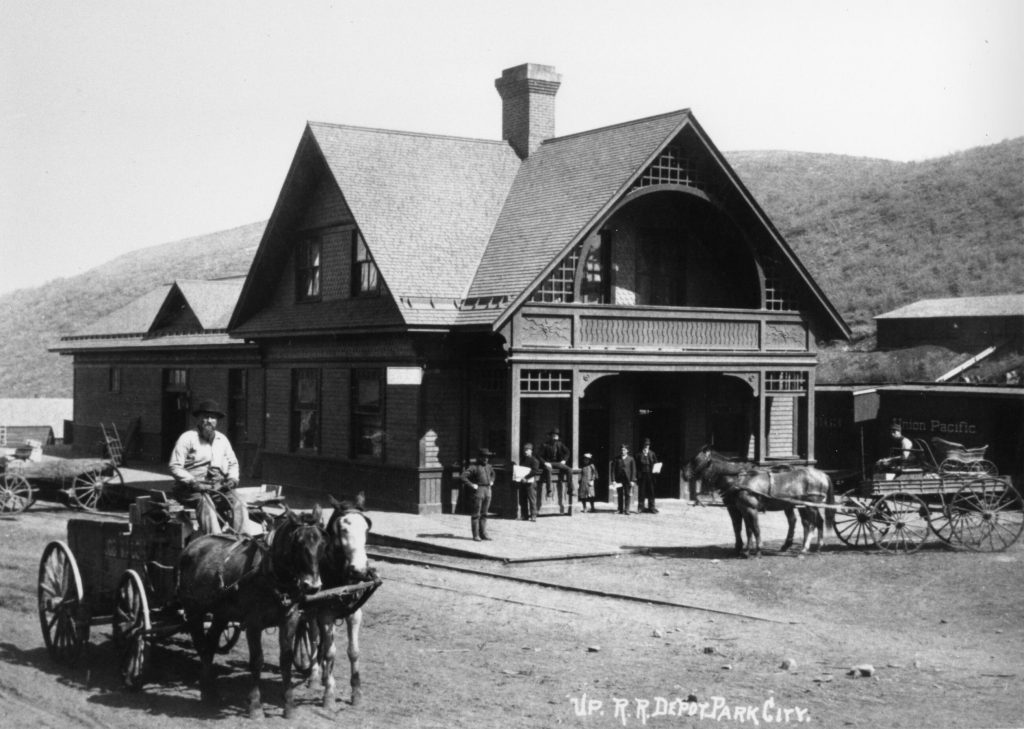
Look for the building with the half-circle porch awning on the second floor off Main Street. That’s the original Union Pacific Railroad Depot, built in 1886. It’s one of the key surviving examples that made this town possible. Can I get a choo….choo?
Like most of America, the introduction of the railroad changed everything for Park City. The rail brought a lot of immigrants. Mostly Chinese and Irish immigrants arrived here first after construction of the nearby Transcontinental Railroad was completed in 1869, twenty-seven miles north of here. It gave the newly established mines a stream of available workers. It also provided mines a way to transport their product around the country.
However, the companies at this point in time still had to transport their unearthed ore down to Salt Lake by horse and wagon. As you can imagine, it was slow, costly and very limiting on how much they could haul out of town. Like a magnet, the mines attracted the construction of two competing railroad line spurs to town. One financed by a local Latter-day Saints entrepreneur. The other by the Union Pacific Railroad.
It was this symbolic metallurgy of the mines melding with the railroad that cast Park City. The spurs connected the town to Salt Lake City. They brought coal and goods in and carried ore out to be smelted in Salt Lake City. Smelting is heating the rock to a molten level to separate out the precious minerals. From there, the separated metals shipped west to San Francisco or east to St. Louis and then beyond.
The railroad spur came up to this depot. There were other connecting rail lines all around here. Some led to mills just nearby, and other tracks led further out to the east, following along where Highway 40/189 is today. It connected up toward Deer Valley to the other mines like the Park Utah and New Park Mines.
Eventually, the Union Pacific line beat out its competition. Though a new competitor moved in with its rail line in 1890, The Denver and Rio Grande Railway. Part of its freight house still survives at 820 Park Avenue.
The rail spurs did much more than catapult the town’s economy. They also brought in passengers. It opened the doors for more immigrants to come to town to work in the mines. Mining was a good-paying gig.
Mining encampments were a lonesome, hardscrabble sort of place. They were mostly a place for solo male miners who were required to live in company-built boarding houses near the mine. They went to work next door and in their off time sought entertainment in town. Gambling, drinking, and brothels tempted their ways to escape.
The rail lines helped tamp down that unsavory element as much as they stoked it. It made it easier for the miners’ wives and their families to join them. It countered the town’s wild “westness” by establishing a sense of community. Women advocated for a free public school, a library, and a hospital for the miners.
The Denver and Rio Grande Railway lasted until the 1940s. The Union Pacific Depot lasted until 1977. Train service on the spur line ended in 1986 with the rail line dismantled in 1989. It gave way to the Historic Summit County Union Pacific Rail Trail. You can access it just north of downtown Park City by Iron Horse and Bonanza Drive.
When you’re ready, head left up Heber Avenue, following the wayfinding signs that will guide you on the Historic Mine Route hike. If you’d like an easier option, continue straight down Main Street to the Town Lift, which you can ride, for a fee, up to the top of Treasure Hill.)