
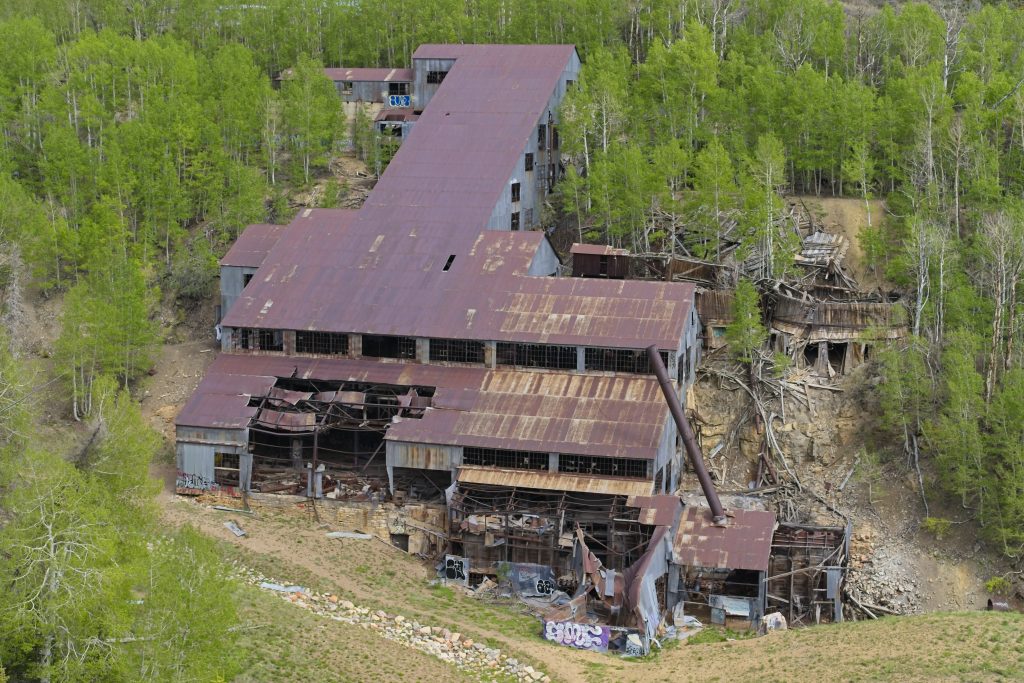
The large building on the far side of the gulch was The Silver King Coalition Mill. The lower photo on the sign shows what it looked like during the later days of its operation. Look again at the building and imagine it surrounded by these lost structures.
The principal minerals found here consisted of lead and silver. Lower concentrations of copper, zinc and gold were also found, which varied by location. Park City miners tunneled from the mine shafts to the ore deposits along horizontal tunnels called “drifts,” and then removed the ore to create large underground openings called “stopes.” Explosives were placed in the drilled holes; explosions broke the rock into smaller pieces. These pieces were then sorted by men known as “muckers,” who would separate “shipping ore” from “milling ore”. “Shipping ore” consisted of hunks of visibly pure mineral, and “milling ore” were hunks that contained the mineral surrounded by sedimentary rock and would require further processing.
At the massive Silver King Mill, the milling ore would first be crushed by machines and turned into a fine sand-like substance. Then, the crushed ore was passed through a series of physical and chemical processes to separate the more valuable “ore concentrate” before being shipped to smelters to melt into the target metals. The remaining sand, known as tailings, was typically disposed of downhill of the mill.
Michael O’Malley is a local mine history raconteur and expert.
The Silver King Coalition mine was formed by combining several mines.
The rocky slope immediately to the right of the mill building was from the Mayflower Mine. Looking down and to the right of The Mayflower, you will see a road. The rocky slope along the road was the location of the Woodside Mine.
The silver fortunes from these mines were discovered in 1889 by miner Thomas Kearns. He was driving a tunnel for the Woodside Mine when he struck a rich silver vein — a natural ribbon or crack in the rock filled with valuable mineral deposits. He realized it crossed into the neighboring Mayflower claim.
Sensing an opportunity to strike it rich, Kearns teamed up with his friend David Keith of the Ontario Mine. They leased the Mayflower claims, leading to the discovery of even more large deposits. The valuable vein extended up the hill into more claims, which became the Silver King Coalition Mine. The operation blossomed into the largest silver producer in Park City’s history.
For those continuing towards Empire Canyon, away from the Silver King Complex, follow the John’s 99 trail to the Mother Urban Crossing. Look at our tour map for help navigating. It’s not too far away.
More Information:
Michael O’Malley Lectures: