
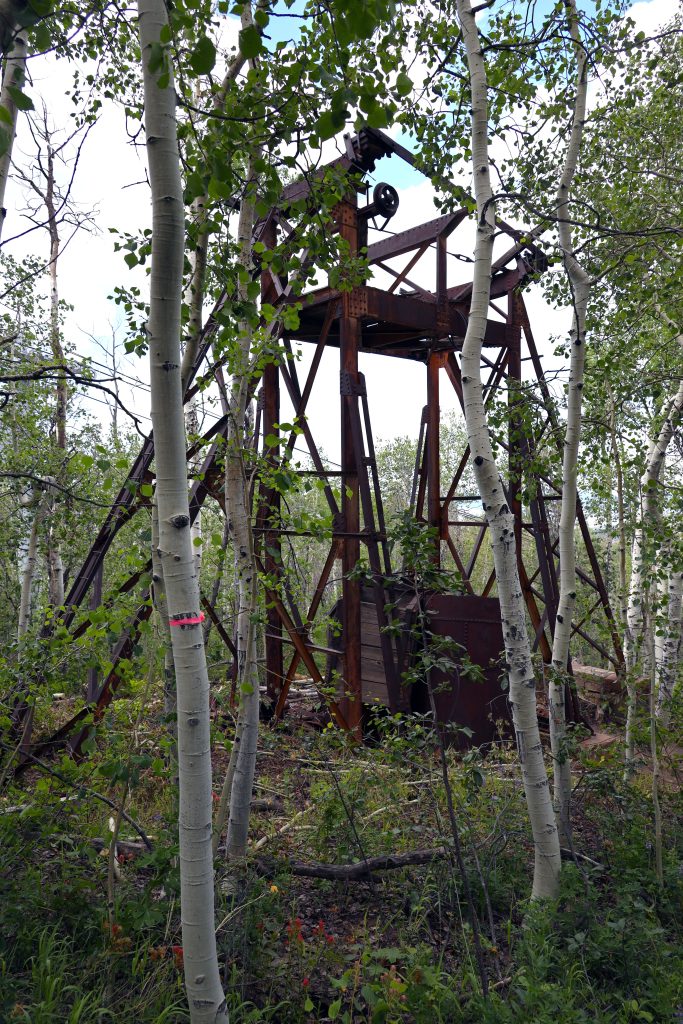
Whew! You are about two-thirds of the way to The Silver King Coalition Mine if you’re hiking uphill. The steel towers along the trail were part of its aerial tram, which carried ore downhill and coal and supplies uphill—a precursor to today’s chairlifts.
Mark Danninger is a modern mining engineer with a passion for historical technologies
You can see, as you’re hiking, how much effort it takes to climb up and down a mountain. Imagine trying to haul tons of materials such as raw minerals or mining supplies up and down the mountain, even during the winter, using a horse and wagon or a train. It was tough. That’s why the aerial tram was such a breakthrough technology in the 1870s. The remote mines here in the mountains could more easily and efficiently transport ore down and mining supplies and coal for fuel uphill.
This aerial tram worked differently from the ski lift you see on the hillside just beyond this tower. That lift uses a single looping cable to carry passengers. Historic aerial trams typically used two cables stretched between towers: a fixed track cable for support and a moving haul cable that pulled large metal ore buckets up and down the line. Huge wheels at each end controlled the haul cable—one a steam-powered, later electric, bull wheel, the other a return wheel. Because loaded buckets traveled downhill, gravity did much of the work.
This particular tower near you served as a tensioning station, keeping the entire line evenly balanced with a counterweight. Modern chairlifts still rely on counterweights, usually hidden at lift stations. The Town Lift you’ve been hiking under has one at the top—see if you can spot it. Around town, you may even notice old ore buckets from the aerial tram that used to hang here, which have been repurposed as garden décor.
The little red house uphill held a hydrant and hose to protect the tensioning station from fire. Similar fire houses stood near many mine buildings, where wooden structures and boilers made fires a constant risk.
Tramway accidents were rare, but in 1907 a frayed cable snapped, sending 80 buckets crashing down, some into town. No one was hurt. The cable was replaced and the tram was running smoothly again within a week.
If you’re continuing uphill to the Silver King Mine complex, enjoy the hike and scenery until the next stop.
Mark Danninger Lectures: