
In the 1930s, ore buckets once moved overhead into this loading station, where their contents dropped into rail cars below. This was the Daly-Judge Aerial Tram, carrying ore from mines above to trains bound for a Salt Lake City smelter. The tram also moved timbers, machine parts, and coal between the rail line, mills, and mines in Empire Canyon.
Completed in 1926, the tram gave the Park Utah Consolidated Mine (formerly the Daly-Judge Mine) a major advantage. It avoided the rough Empire Canyon road, often blocked by snow in the winter and mud in the spring, and helped the mine compete with the Silver King, which had operated its own aerial tram since 1901.
Ore emptied from tram buckets on the building’s fourth floor into train cars below. The middle floors stored supplies that headed uphill, while the first floor housed a lumber mill that cut wood for underground use.
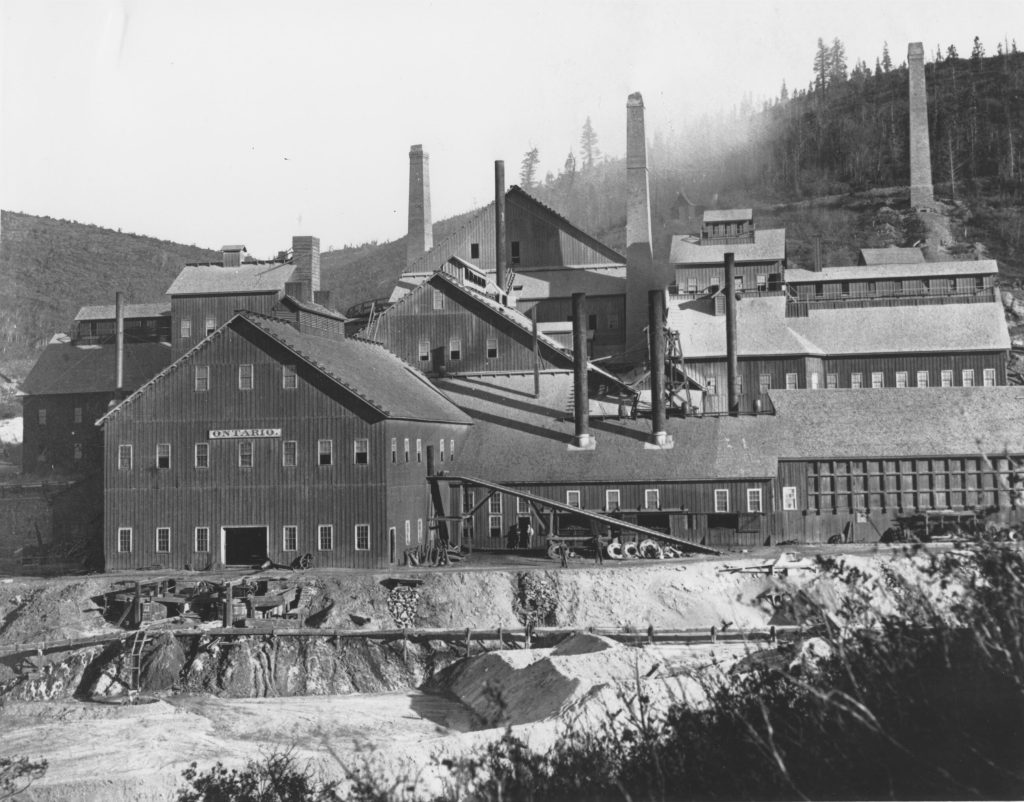
Just uphill to your right, another sign marks the site of the Ontario Mill. Park City miners dug for silver and lead here, along with smaller amounts of copper, zinc, and gold. Underground, miners blasted ore from large chambers called stopes. Workers known as muckers sorted the broken rock into shipping ore, sent straight to the smelter, and milling ore, sent for further processing.
At the mill, machines crushed ore into a fine sand-like material. The roar of stamping machinery once echoed through this canyon day and night. The crushed ore then went through more processing to produce concentrate for shipment to smelters. The leftover waste, called tailings, was piled nearby. A large tailings pile still sits uphill and now serves as a runaway truck ramp on steep Marsac Avenue.
The Ontario Silver Mine was discovered in 1872 by prospector Henry Budden. According to local tradition, he noticed the glint of galena in a rock while walking to camp and recovered the broken sample. The mineral galena, recognizable by its bright metallic luster, was a common first clue for prospectors. Its mirror-like gleam in rock faces often signaled a nearby silver or lead deposit. Tests showed rich silver and lead content. After a local sale fell through, George Hearst’s associate R.C. Chambers bought the claim for $27,000. The mine later returned more than $50 million in dividends, nearly one and a half billion in 2026 dollars, helping fund the Hearst family fortune.