
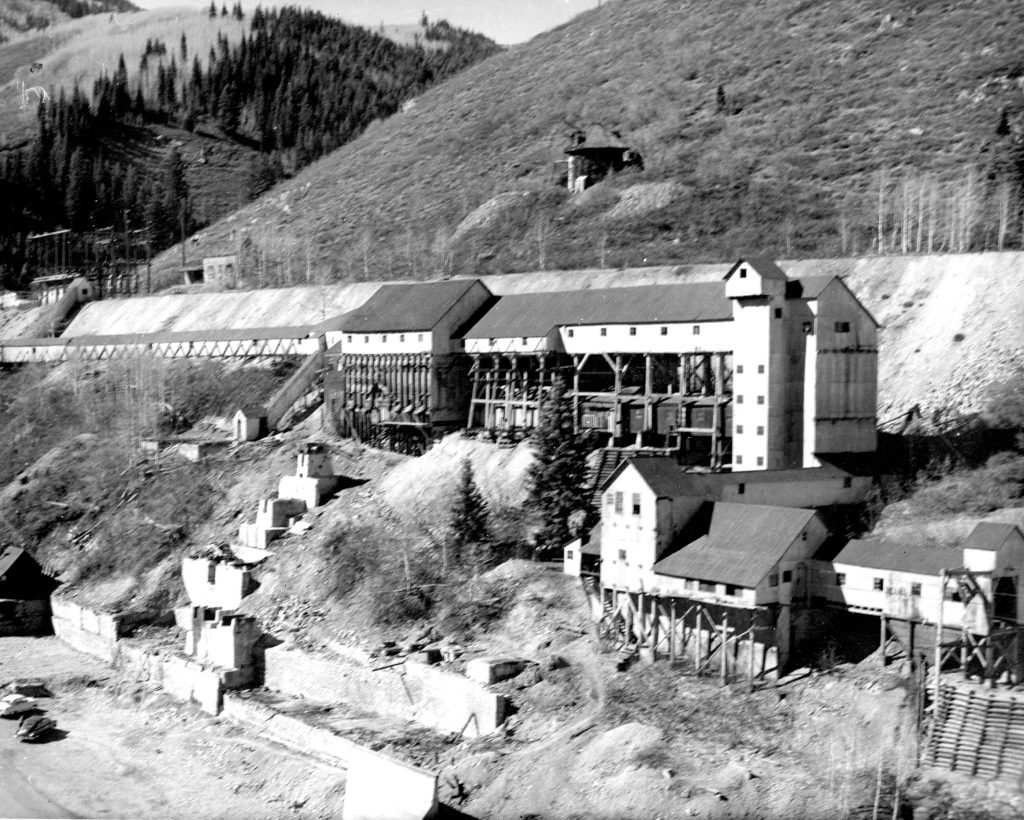
Just below you once stood the massive Daly-Judge Mill. The concrete foundation with the power-line pole marks the Superintendent’s house shown on the sign. The mill processed ore delivered by mine cars from the Judge Tunnel to the left of the Judge Mining and Smelting building behind you.
Donovan Symonds holds a B.S. in mining engineering from Newcastle University and a Ph.D. in mineral processing from Nottingham University. Donovan is a Park City Museum docent and helped start the Friends of Ski Mountain Mining History Lecture Series.
While some of the ore mined in Park City was rich enough in mineral content to be shipped directly to the smelter, a lot of what was pulled out of the ground was processed in a local mill before shipping.
The Daly-Judge mill was laid out in the typical hillside configuration of western mines, using gravity to move ore downward through successive processing stages. Ore was brought in at the top level of the mill. It was crushed and ground before being processed with machines called jigs and tables that shook or washed the ore so heavier valuable grains, called concentrates, would be separated from the lighter waste, called tailings.
By about 1915, the introduction of froth flotation marked a major shift in the milling process; this is where finely ground ore is mixed with water, chemicals, and air bubbles. Valuable mineral particles stick to the bubbles and float to the top as foam. The tailings sink to the bottom, allowing the mill to recover and separate silver-lead and zinc sulfide concentrates more efficiently.
Only the concrete foundations of the mill remain, visible across the canyon. One building survives elsewhere: the house shown at center left on the sign was moved to Thaynes Canyon.
Daly-Judge ore also contained significant zinc. The mill was adapted to separate the zinc concentrate, which John Daly stockpiled until rising demand for rust-resistant zinc-coated steel made it highly profitable in the early 20th century.
At first, the zinc concentrate was sold to another smelter. In 1916, the company built its own smelter near today’s Snow Park area of Deer Valley Resort.
Looking down-canyon, search for a steel tower on the sandy slope behind the trees. It was part of a 1920s Daly-Judge aerial tram, the third of Park City’s three mining trams. Towers from the other two, the Silver King Coalition Mine Aerial Tram and the Silver King Consolidated Aerial Tram, still stand at Park City Mountain Resort.
More Information:
Donovan Symonds Lectures:
Shiny Rocks to Silver Bars: A Brief Explanation of Milling