
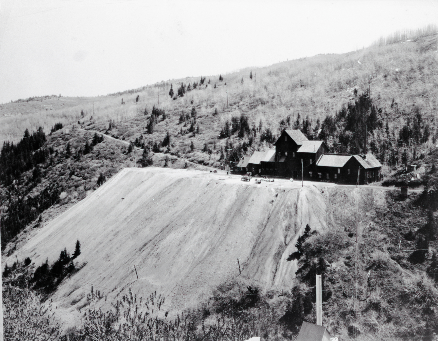
The Interpretive Sign shows what The American Flag Mine looked like back in the day. The hillsides were stripped of trees long before the early 1900s, which is the date of the photo. The timber was used to fuel wood-fired boilers and as structural support in the mines. Some old timers say there aren’t trees older than 150 years around these mountains because the miners cut them all down!
All that remains of the American Flag Mine buildings are concrete footings and the loose rocks on which you stand. The rocks were blasted out of the mountain and hauled to the top of the mine shaft to be dumped in a pile, as shown in the photo. That rockpile was eventually bulldozed to make the road. Don’t worry! The shaft was sealed long ago for safety reasons.
Like many of the smaller mines in Park City, The American Flag ultimately showed more promise than actual output. Perhaps this is why Mark Twain offered this general observation: “A mine is a hole in the ground. The discoverer of it is a natural liar. The hole in the ground and the liar combine and issue shares and trap fools.”
The mine was founded in 1902 by a couple of gentlemen who saw great promise in the ground between two of the great mines of Park City, the Ontario and the Silver King Coalition. The American Flag had a shaft 1,290 feet deep and multiple working levels. It was one of the few mines that had significant quantities of gold, since its ore consisted of a silver-gold mineral which contained very little lead. This early “shipping ore” could be sent directly to the smelter. It was very profitable and yielded more than $500,000 in proceeds to the mine owners.
The economic challenge for The American Flag, which led to its demise, was the nature of its “second-class ore.” This less-valuable ore was so deep and had to be milled locally before shipping to the smelter that it added considerable expense. The mine ultimately failed due to these economics.
For a few years after its founding, there were many glowing reports of the development of the American Flag Mine, but after 1917, articles about the American Flag Mine simply disappeared from the newspapers. Were the founders engaged in an elaborate “pump and dump” scheme, where the profits shown during the early shipments of high-grade ore were used to “trap fools” as Mark Twain suggests? This is pure speculation. There was no Securities and Exchange Commission to prosecute perpetrators of “stock schemes” in those days. All we do know is that the mill built to service The American Flag was sold to Solon Spiro later that year and incorporated into his King Con mine during the same year as the failure of The American Flag. Others did not resume mining operations here until the early 1930s.